For many American Evangelicals, ’tis the season to get our knickers in a twist about all things Halloween. This is just one of those things we do to avoid the appearance of evil, and we sometimes look a tad silly doing it. So, full confession: I’ve taken every one of my kids trick-or-treating, and I have shamelessly levied a Parent Tax on their earnings. I apologize for nothing, and furthermore, enough of the Smarties and candy corn, people. If I’m going to have to traipse around in the cold for an hour watching my kids go door to door, I want more Kit Kats. Sheesh.
In all seriousness, if you aren’t into Halloween that’s fine. In fact, I totally understand it. I don’t have much enthusiasm for it as a holiday and have no use at all for celebration of zombies and guts and gore. And I’m obviously uncomfortable with some of the darker spiritual overtones which have come to be attached to Halloween. But I also remain unconvinced that harvest parties and public denunciations do much to offer meaningful alternatives.
What’s most tragic to me, though, is that the most credible alternative is right under our nose. As it turns out, our contemporary celebration of Halloween is actually a transmogrification of something pretty worthwhile.
A Celebration of Heroes
The name “Halloween” is a corruption of “All Hallows Eve.” That means little to American Evangelicals because of our ecclesiastical heritage and theological emphases, and because we think Hallows are magical items in the Harry Potter universe. But, in fact, a “hallow” is a sacred thing…or a sacred person. Another word for “hallows” is “saints,” and another name for Halloween is All Saints Eve.
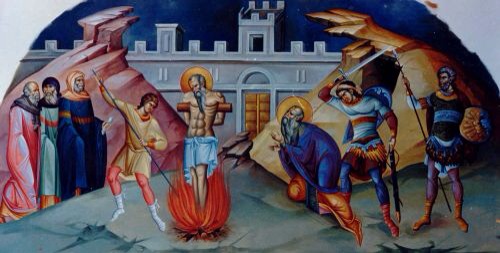
All Saints Eve precedes All Saints Day, which in Catholic and Orthodox tradition is a remembrance of departed Christians now in Heaven, dwelling victoriously in Christ. In fact, the holiday in its most ancient form is a springtime commemoration (which mirrors the modern observance of All Saints Day in the Orthodox Church) of the innumerable martyrs who died in defense of the faith under Roman persecution. It was (and in Orthodox and Catholic liturgy, still is) customary to remember martyrs on the anniversary of their deaths, but during the last and most brutal Roman persecutions far too many Christians were executed to memorialize individually. So the holiday that evolved into All Saints Day was originally intended as something like Memorial Day in the United States today, a day to remember all who had given their lives in the name of Christ.
Because of the Reformation’s rejection of the concept of merit (which is heavily bound up in the Catholic conception of sainthood), Protestants have for the most part rejected the value of All Saints Day. And in typical Protestant fashion, we throw out the baby with the bathwater in the interests of theological purity. Understand that I’m not advocating the adoption of practices I find at best confusing (such as the veneration of icons) and at worst destructive (like indulgences), but I think it is a shame when we abandon centuries of our own history, heritage, and heroes because of an overcorrection.
A Useful Halloween Alternative
The Evangelical instinct to replace Halloween with a harvest party rather than reclaim it by returning it to its roots is part of the larger Protestant tendency to forget our history. We just don’t know where we came from or how we got here, and we’re poorer for it.
From Polycarp to Dietrich Bonhoeffer, from the martyrs of Nero to the martyrs of the Islamic State, we are surrounded by a great cloud of witnesses whose stories are a testimony to the power of Christ at work in them. Their stories can be a tremendous source of inspiration for us. They teach us not only how to die for Christ, but also how to live for him amidst confusing and difficult circumstances.
We can also find common ground with those Saints who were never called upon to make the ultimate sacrifice. It has become customary for me to preach Romans 1:16-17 as Martin Luther near Reformation Day (which also happens to be October 31). Few of us will ever start a theological revolution that will turn the world upside down, but we all have to navigate the journey from faith in our own selves and activities to faith in Christ. Knowing our story can help us do that.
We have the perfect Halloween alternative in our own history and traditions, and it shouldn’t be too hard to work Kit Kats into our celebration with credibility. All Saints Eve and All Saints Day provide Christians an opportunity to remember who we are by remembering who we’ve been.
Icon courtesy of www.eikonografos.com. Used with permission.
 The Friday Blahg
Hello mate great blog posst
LikeLike